Norwood scale, stages 1 to 7
How bald am I? Find your Norwood stage
If your temples have receded or your crown is thinning, the Norwood scale tells you where that sits on the standard pattern of male hair loss. This is a visual self-check, not a diagnosis.
Choose the pattern closest to yours. Each pair shows the side and top; the front of the top view points down.
What is the Norwood scale?
The Norwood scale is the standard classification for male pattern hair loss. It was published by dermatologist O'Tar Norwood in 1975, building on James Hamilton's 1951 work, and it describes seven stages from a full hairline (stage 1) to a narrow horseshoe of remaining hair (stage 7). Stage 3 is the first stage Norwood classed as balding.
Hair loss on the scale follows two routes that often combine: recession at the temples, which sharpens the hairline into an M, and thinning at the crown (the vertex). Stage 3 vertex is a separate category because it marks the point where both are happening at once. From stage 4 the two areas grow toward each other; at stage 6 they merge.
Dermatologists and hair transplant surgeons use the scale to describe a pattern, plan how many grafts a procedure needs and compare results. It does not measure hair density or diagnose the cause of hair loss; diffuse thinning, alopecia areata and telogen effluvium all sit outside it.
Norwood scale chart
The original chart draws every stage twice: a side profile, which shows how far the hairline has moved back, and a top view, which shows the crown. The A variants (2A to 5A) follow the same stage numbers but the hairline recedes as one straight front without the temple notches or a forelock.
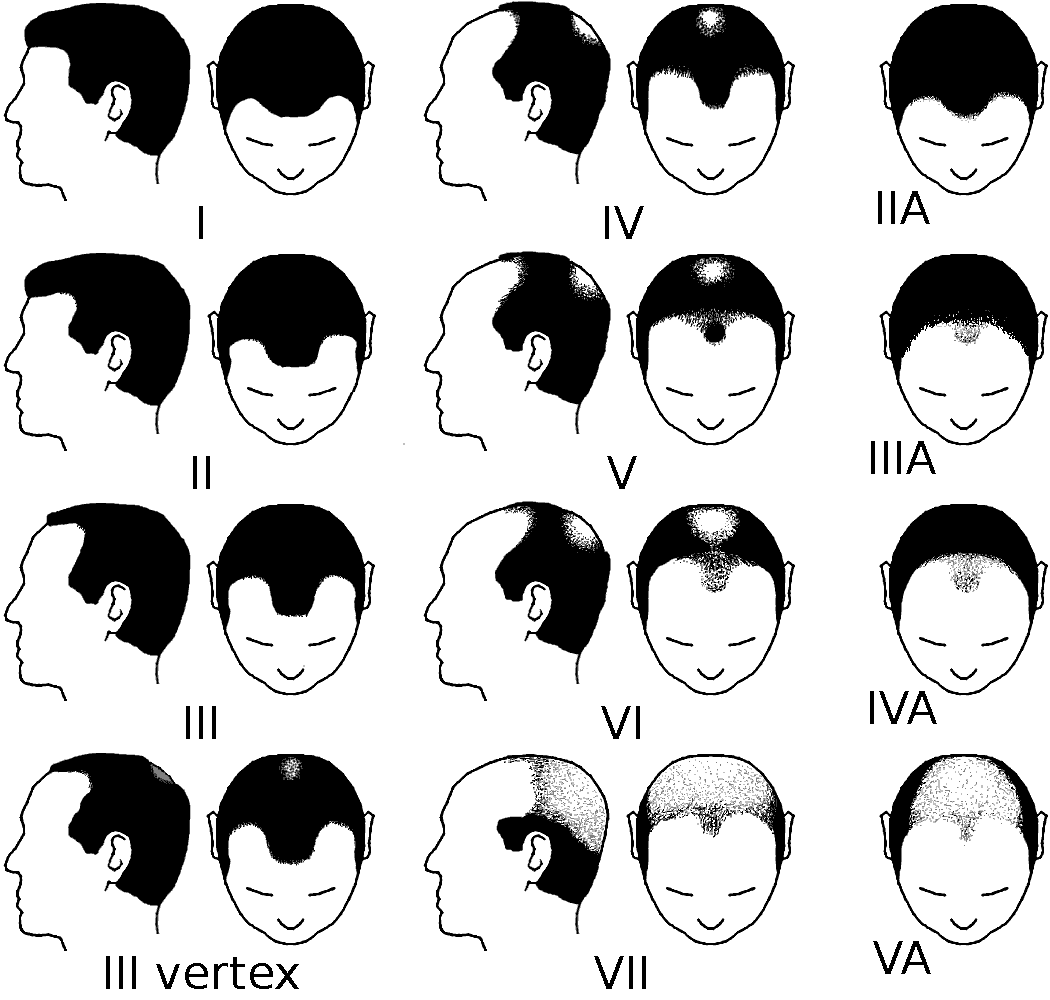
The 7 Norwood stages at a glance
| Stage | What it looks like | Balding? | Typical grafts | |
|---|---|---|---|---|
Norwood 1 | No meaningful recession. A full, juvenile or adolescent hairline with no visible thinning at the temples or crown. | No | None | Details → |
Norwood 2 | Slight, symmetrical recession at the temples. Often a "mature hairline" rather than the start of balding. | No | 500 to 1,500 | Details → |
Norwood 3 | Deep, symmetrical temple recession forming a clear M, U or V shape. The first stage Norwood classed as balding. | Yes | 1,000 to 2,000 | Details → |
Norwood 3 Vertex | Stage 3 temple recession plus a thinning spot at the crown. Hair loss in two places at once. | Yes | 1,500 to 2,500 | Details → |
Norwood 4 | Deeper frontal recession and a clear bald patch at the crown, still separated by a solid band of hair across the top. | Yes | 2,000 to 3,000 | Details → |
Norwood 5 | Larger front and crown bald areas with only a narrow, thinning band of hair left between them. | Yes | 2,500 to 4,000 | Details → |
Norwood 6 | The front and crown bald areas have merged. Hair remains only on the sides and back, with some thinning there too. | Yes | 3,500 to 5,500 | Details → |
Norwood 7 | The most advanced stage. Only a narrow horseshoe of hair remains around the sides and back, often fine and thinning itself. | Yes | 5,000 to 7,000 | Details → |
Mature hairline vs receding hairline
A mature hairline is a Norwood 2 that stops moving. The juvenile hairline settles back into its adult position between the late teens and the late twenties, and for many men that is where it stays. A receding hairline keeps going: the temples deepen, the M sharpens and the pattern reaches stage 3.
Movement over time is the clearest signal, but it is not the only one. Hair calibre at the front edge, crown involvement and the shape of the change all help separate the two before a year of photographs can. Our five-sign check walks through each one, and the Norwood 2 page covers what people at that stage typically do while they wait to find out.
Women: the Ludwig scale
The Norwood scale describes the male pattern. Female pattern hair loss usually thins the crown and widens the part while the front hairline holds, so it is graded on the Ludwig scale (grades I to III) instead. The stage finder above will not match a female pattern well. Our hair transplant guide for women explains which patterns may be transplantable and why donor-area quality matters.
Grafts times per-graft price, across nine countries. Turkey, the US, the UK and more.
What the trials found at two, four, six and twelve months, plus shedding and what happens after stopping.
Trial results from month three through year five, including shedding, hairline limits and stopping.
Candidacy by hair-loss type, FUE vs FUT, results, risks and the questions to ask before a deposit.
Norwood scale: frequently asked questions
- How accurate is a Norwood self-assessment?
- Good enough to place most men within one stage. The scale was designed from photographs, so matching your own hairline and crown to the standard patterns is how it is meant to be used. It cannot detect diffuse thinning, hair miniaturization or other causes of hair loss, which a dermatologist assesses with a scalp exam and, where needed, a dermoscope.
- What Norwood stage is considered balding?
- Stage 3 is the first stage Norwood classified as male pattern baldness. Stages 1 and 2 describe a juvenile and a mature hairline respectively; stage 2 can look like early recession but frequently never progresses.
- Can you go back a Norwood stage?
- Sometimes, partly. In the 5-year finasteride trials about two-thirds of men had some regrowth, and minoxidil thickens miniaturized hairs, so men with early thinning can look a stage younger. Fully bare skin with no follicles does not regrow with medication; a transplant is the only way to restore hair there.
- What stage is too late for a hair transplant?
- There is no fixed cutoff, but the limiting factor from stage 5 onward is donor supply. A typical scalp yields roughly 5,000 to 7,000 grafts over a lifetime, which is enough to frame the face at stage 6 but rarely enough to cover a stage 7 scalp at natural density. Surgeons assess the donor area before quoting.
- How fast does hair loss progress through the stages?
- Unpredictably. Norwood reported that about a quarter of men show some loss by 30 and about half by 50, but individual pace depends on genetics and age of onset. Men who start early tend to progress further. Photos in consistent lighting every 6 to 12 months are the simplest way to measure your own rate.
Sources
Stage definitions follow Norwood's 1975 classification. Graft ranges are typical clinic planning estimates for a first session, not quotes.
How Bald is an information site, not a clinic. Nothing here is medical advice and we do not sell procedures or medication. Figures are estimates with sources listed on our methodology page. Talk to a dermatologist or hair restoration surgeon before treatment.